
Is an invoice the same as a bill? Ask ten shopkeepers and you will hear ten confident answers that do not all match. In casual speech people swap the words freely. In accounting and GST law, the two words describe different documents, and mixing them up can cost you input tax credit or a delayed payment.
This explainer settles the question in plain language, with Indian examples. If you want to create either document right away, the free tools on the InstantBillMaker homepage cover both.
The short answer: is an invoice the same as a bill?
Mostly yes in conversation, and no in law. The seller creates an invoice to request payment. The buyer receives it and records it as a bill to pay. So the same piece of paper has two names, depending on whose desk it sits on. That is why the phrase “an invoice is a bill” sounds right to most people.
Indian GST adds a second meaning. The Central GST Rules treat a tax invoice and a bill of supply as two separate documents with separate rules. Which one you issue depends on what you sell and how you are registered, not on which word you prefer.
Billing invoice meaning in everyday terms
When someone says billing invoice, they usually mean the invoice a seller sends for work done or goods delivered. It lists what the buyer owes, how the amount was calculated and when to pay. It is a request for payment backed by details, and it also serves as the seller’s record of the sale.
Billing is the activity around it. A business bills a client when it calculates the amount owed and sends the document. An invoice is the document itself.
So when you say you will bill the invoice, you mean you will send it and start the payment clock. The two words describe an action and the paper it produces.
A simple example makes this concrete. A plumber fixes a leaking tank on Monday. On Tuesday the plumber writes an invoice for ₹3,500 and hands it over. The customer writes the amount in a notebook as a bill to pay by Friday. One document, two points of view.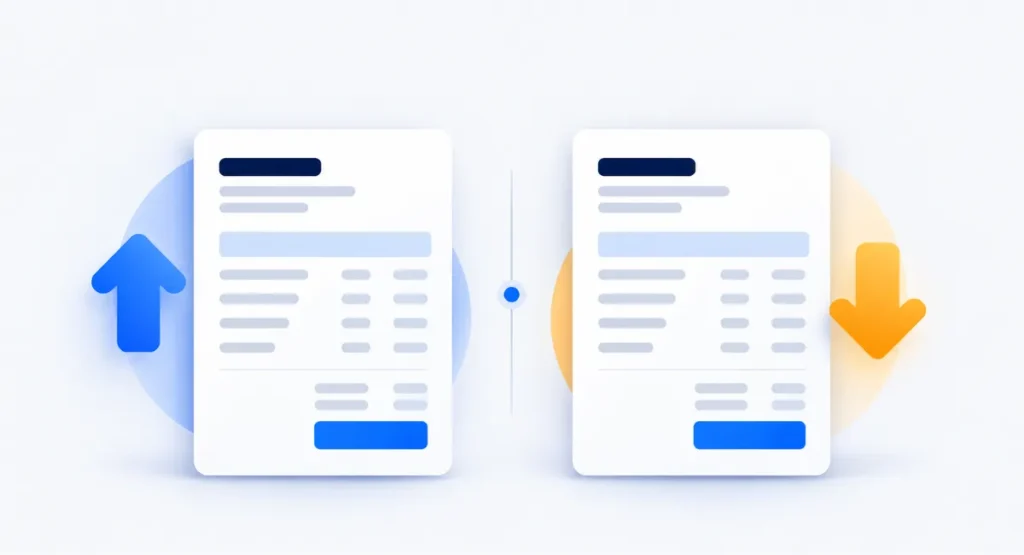
Two sides of one sale
The cleanest way to remember the difference is to ask who holds the document and what they do with it.
| Question | Invoice | Bill |
|---|---|---|
| Who creates it? | The seller or service provider | The seller (the buyer simply receives it) |
| Whose record is it? | Accounts receivable, money coming in | Accounts payable, money going out |
| What is its job? | Request payment and prove the sale | Remind the buyer what to pay |
| When does it appear? | After the sale or delivery | After the buyer receives the invoice |
| GST angle | Tax invoice with tax lines | Bill of supply when no tax is charged |
Notice the last row. The informal sense of bill (the buyer’s payable) and the legal sense of bill of supply are not the same idea. Keep them apart in your head and most of the confusion disappears.
Invoice and bill under GST
The GST Council guide to tax invoices explains the legal split. A registered person who makes taxable supplies issues a tax invoice. A registered person who deals only in exempt supplies, or who pays tax under the composition scheme, issues a bill of supply instead. A person liable under reverse charge issues a payment voucher when paying the supplier.
The two documents carry different content. A tax invoice has up to 16 fields, including the rate and amount of each tax. A bill of supply has 8 fields and no tax lines, because the supplier does not charge tax.
A business that sells both taxable and exempt goods can use a single invoice-cum-bill of supply under Rule 46A.
The choice affects your buyer. A buyer can claim input tax credit only with a valid tax invoice. A bill of supply gives the buyer nothing to claim, since no tax was charged. If you issue the wrong document, your client may lose credit and send the paperwork back.
| Feature | Tax invoice | Bill of supply |
|---|---|---|
| Issued by | Registered supplier of taxable goods or services | Exempt supplier or composition dealer |
| Tax charged | Yes: CGST, SGST or IGST | No |
| Number of particulars | Up to 16 fields, applicable ones only | 8 fields |
| Buyer can claim ITC | Yes, if all conditions are met | No |
| Serial number | Unique per financial year, up to 16 characters | Unique per financial year |
To see a tax invoice laid out line by line, look at the five filled samples in free invoice examples, which show the tax split for services, goods and retail sales.
Billing and invoicing: the process behind the paper
Invoice billing, as many teams call the routine, is a short chain of steps. A business agrees on a price, delivers the work, issues the invoice, collects payment and records the receipt. People say billing and invoicing together because both live inside the same finance routine.
The difference between invoice and billing becomes clearer when you picture the steps. Invoicing is the step where you produce the document. Billing is the larger cycle that includes quoting, tracking due dates, sending reminders and matching payments.
A tool that only writes invoices handles one step. A billing system handles the cycle.
Small businesses can run the cycle with a few simple documents and a spreadsheet. The important part is that every document links back to the one before it. A receipt names the invoice number, and an invoice names the quote or work order it came from.
A worked example: one sale, four documents
A short story shows how the pieces fit. Sharma Fabrication, a registered workshop in Ludhiana, agrees to build a steel gate for a local school. Here is the paper trail from first call to final payment.
| Stage | Document | What it says |
|---|---|---|
| 1 | Quotation | Gate fabrication and fitting, ₹50,000 plus GST, valid for 15 days |
| 2 | Proforma invoice | Advance of ₹10,000 requested before work starts |
| 3 | Tax invoice at delivery | Taxable value ₹50,000, CGST ₹4,500, SGST ₹4,500, total ₹59,000 |
| 4 | Receipt | ₹10,000 advance received earlier, balance ₹49,000 paid on 12 November |
The school reads each of these differently. The quotation helps the principal get approval. The proforma helps the accounts clerk release the advance. The tax invoice becomes the official sale record, and the school’s auditor files it. The receipt closes the loop.
Remove any one step and something breaks. Without the tax invoice, the workshop has no legal record of the sale. Without the receipt, the school cannot show it paid the balance.
If Sharma Fabrication had skipped the quotation, the price could become an argument at delivery. Each paper has a small, clear job, and together they make the sale easy to audit.
The wider document family
Invoices rarely travel alone. Several neighbouring documents get confused with them, and each one has a clear job.
-
- Quotation or estimate: a price offer before any work starts. It commits nothing until the buyer accepts. You can draft one with the quotation and estimate maker.
-
- Proforma invoice: a preliminary bill that asks for an advance or helps with customs. It is not a tax invoice, so it cannot support input tax credit. The proforma invoice maker builds one with multi-currency support.
-
- Delivery challan: a dispatch paper used when goods move without a sale, for example for job work or supply on approval. The delivery challan generator produces it with the vehicle details.
-
- Receipt: proof that payment arrived. A cash receipt names the invoice and the amount.
-
- Credit note and debit note: documents that correct an invoice after the fact. A credit note lowers the amount, and a debit note raises it. Their serial numbers also stay within 16 characters.
Each of these answers a different question. A quote asks, “Will you buy at this price?” An invoice asks, “Will you pay what you owe?” A receipt answers, “Yes, and thank you.” Using the right one at the right time keeps your records clean.
Which document should you issue?
Use this short decision guide when you are not sure.
-
- You are registered and you sell taxable goods or services: issue a tax invoice.
-
- You sell only exempt goods or services, or you use the composition scheme: issue a bill of supply.
-
- You are quoting a price before the work: send a quotation.
-
- The client needs an advance payment document: send a proforma invoice.
-
- You are moving goods without a sale: prepare a delivery challan.
-
- The client has paid: issue a receipt.
-
- You are unregistered: issue a plain invoice with no tax lines.
The complete steps for making the first document on that list, including numbering, timing and tax, are in our guide on how to make a legal invoice.
Mistakes people make when mixing the two
-
- Sending a proforma invoice and expecting the buyer to claim credit. Only a valid tax invoice supports that claim.
-
- Charging GST on a bill of supply. A composition dealer cannot collect tax from customers.
-
- Calling every document an invoice in the books. Purchase bills, sales invoices and credit notes need separate series.
-
- Skipping the invoice because the client already received a quote. A quote never replaces a tax invoice.
-
- Treating a receipt as an invoice. A receipt shows money received. It does not create a tax liability by itself.
Most of these slip-ups come from using one template for everything. Keep one layout per document type, and label each clearly at the top of the page.
Questions people ask
Is an invoice a bill or a receipt?
An invoice is a request for payment. A receipt is proof that the payment arrived. You issue the invoice first and the receipt after the money lands.
Can one document work as both an invoice and a bill of supply?
Yes, in one case. A registered person who supplies both taxable and exempt goods or services can issue an invoice-cum-bill of supply under Rule 46A, instead of two separate papers.
Does a small business need to issue invoices at all?
If you are registered under GST, yes for taxable supplies. If you are unregistered, the law does not force a tax invoice on you, but a plain invoice still protects you in a payment dispute and gives your client a clean record.
Where can I create an invoice or bill quickly?
Open the GST invoice maker for a tax invoice, or choose another document from the tool list on the homepage. Each one exports an A4 PDF without a watermark.