A delivery challan moves goods; an e-way bill is the GST electronic permission slip that must travel with most consignments above the notified value threshold. Confusing the two is common on Indian sites, and costly when the truck is checked without a valid e-way bill.
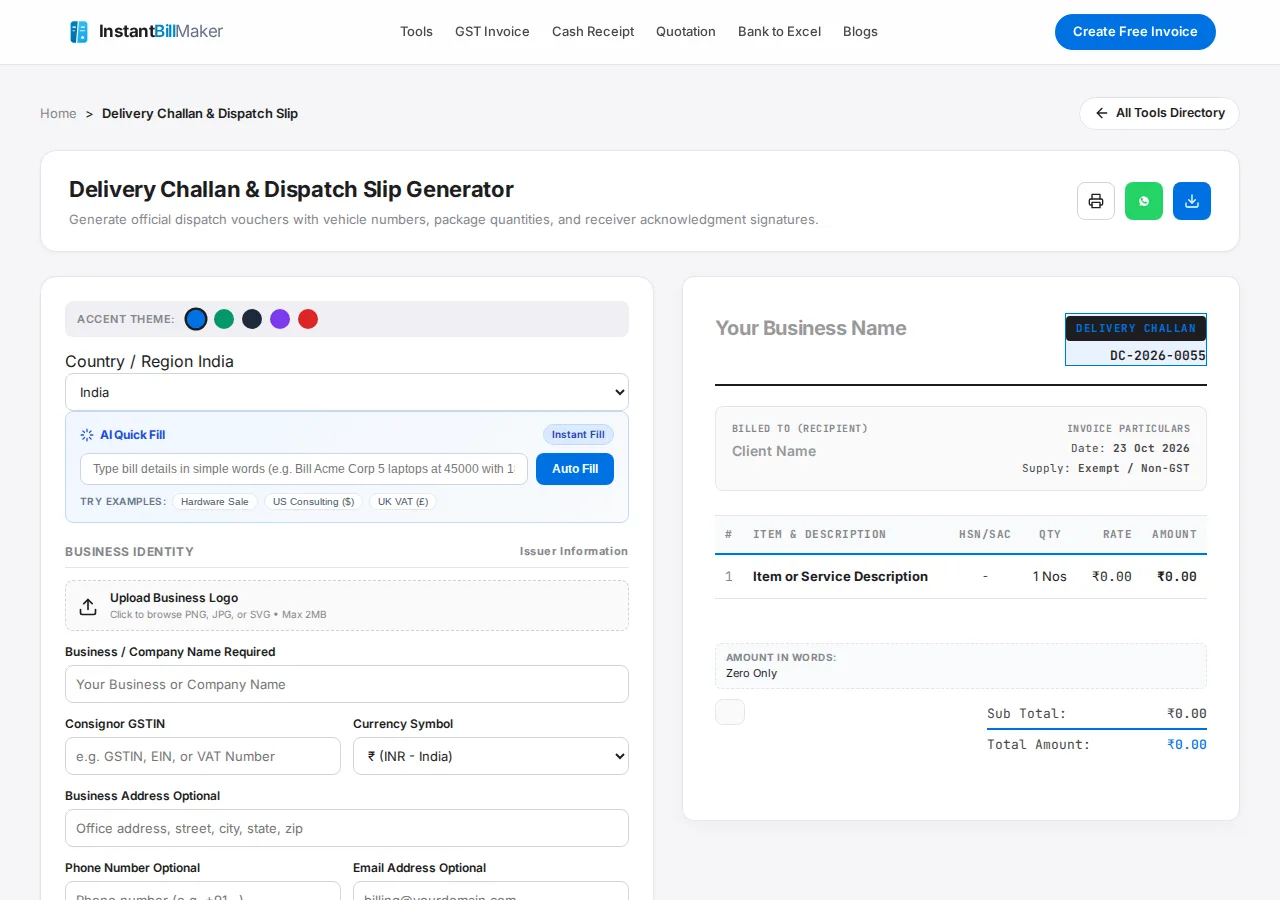
This guide explains delivery challan vs e-way bill in plain language: when each is required, what fields they share, how they relate to the tax invoice, and how to build a clean challan with the free Delivery Challan & Dispatch Slip tool.
What is a delivery challan?
A delivery challan is the paper (or PDF) that accompanies goods when they leave your premises before, or instead of, an immediate tax invoice. It records what was dispatched, to whom, in what quantity, and on what vehicle. Common cases:
- Job work returns and goods sent for processing
- Approval or free-of-cost supply within notified limits
- Oil, gas, or other continuous supply where invoice timing differs from dispatch
- Transport of goods where the tax invoice is issued on delivery or at a later milestone
Under the CGST Rules, a tax invoice can be accompanied by a delivery challan, and the invoice may be issued at the time of delivery based on the challan quantities. Keep challan numbers sequential and reconcile them to the final invoice, mismatches are a classic audit thread.
What is an e-way bill?
The e-way bill is the electronic document generated on the GST portal (or API) when goods are moved and the consignment value exceeds the threshold set under Rule 138 of the CGST Rules (₹50,000 as a common all-India baseline, with notified exceptions).
It carries part A data (GSTINs, HSN, value, document number) and part B data (vehicle number, transporter). The driver or transporter must be able to produce it when asked.
E-way bill validity depends on distance and mode of transport. If the vehicle changes, update part B within the allowed window; an expired or mismatched e-way bill is treated as if none exists.
Delivery challan vs e-way bill: side-by-side
| Delivery challan | E-way bill | |
|---|---|---|
| Issued by | Supplier / job worker | GST portal or API by supplier, recipient, or transporter |
| Purpose | Proof of dispatch and quantity moved | Electronic movement permit for GST enforcement |
| Value threshold | Not value-gated; used whenever goods move without immediate invoice | Mandatory above notified value (commonly ₹50,000) |
| Vehicle details | Optional but useful | Part B required before movement (with exceptions) |
| Turns into | Supports the tax invoice at delivery | Independent compliance document; must match invoice data |
You often need both: a delivery challan for your internal dispatch record and a tax invoice for the supply, plus an e-way bill for the road. Having a challan does not replace the e-way bill. When the tax invoice is B2B and your turnover crosses the e-invoice threshold, that invoice also needs an IRN from an Invoice Registration Portal, as E-invoice in India explains.
When you do not need an e-way bill
Notified categories move without an e-way bill, for example certain empty cargo containers, non-taxable goods, or consignments handled by customs bonded routes, subject to the rules in force. Do not rely on memory; check the current exemption list on the GST portal before you skip generation.
Intra-company movements for job work still need paper discipline: challan out, challan in, and invoice when the processed goods return.
How challan, invoice, and e-way bill numbers should match
- Create the delivery challan with a unique number for the dispatch.
- Generate the e-way bill quoting the challan (or invoice) number as the document reference.
- Issue the tax invoice when liability arises, same goods, same quantities, same HSN.
- Close the loop in your books: challan → e-way bill → invoice → payment.
Quantity shortfalls on arrival should be recorded, not rewritten. Credit notes and supplementary invoices are cleaner than a silent edit to the original challan.
Build a delivery challan free online
Open the Delivery Challan & Dispatch Slip tool, enter consignor and consignee details, goods lines with HSN, vehicle and transporter fields, then download the PDF.
Pair it with the GST invoice maker when the tax invoice is due, or the purchase order generator if the buyer needs a PO reference on the sheet.
For priced offers that have not become dispatches yet, use the quotation builder. Do not send a challan as a quotation, buyers treat it as a goods movement document.
FAQ
Is a delivery challan the same as an e-way bill?
No. The challan documents the physical dispatch. The e-way bill is the GST electronic movement permit generated on the portal when value and rules require it. Both may be needed for one consignment.
When is an e-way bill mandatory in India?
Generally when the consignment value exceeds the threshold under Rule 138 (commonly ₹50,000), with notified exceptions. Always confirm the current threshold and exemptions on the official GST portal.
Can I issue an invoice using a delivery challan?
Yes. Rules allow the tax invoice to be issued at the time of delivery based on challan quantities for certain supply types. Keep numbers and quantities reconciled.
Do I need an e-way bill for job work?
Often yes when goods cross the value threshold and move to a job worker. Challans still track what left and what returned; the e-way bill covers the road movement.
Where can I make a free delivery challan?
InstantBillMaker’s Delivery Challan & Dispatch Slip builder outputs a clean PDF in the browser. No signup, no watermark.