Invoice billing is how a business turns completed work into a paid document. The seller issues a billing invoice, the buyer records it as a bill, and payment follows. In India the same paperwork also has to satisfy GST rules, so “invoice” and “bill” are not always interchangeable.
A guide explains what belongs on the document; the free bill generator no sign-up writes those same fields while you type.
The online builder produces a finished file in seconds, while the freelance billing invoice template gives you a spreadsheet you can reuse for every retainer week.
A blank copy of the structure in this guide is available as the free invoice template PDF and Excel download.
When an invoice goes out with the wrong value or tax, the correction happens through a credit note or a debit note, never a silent edit.
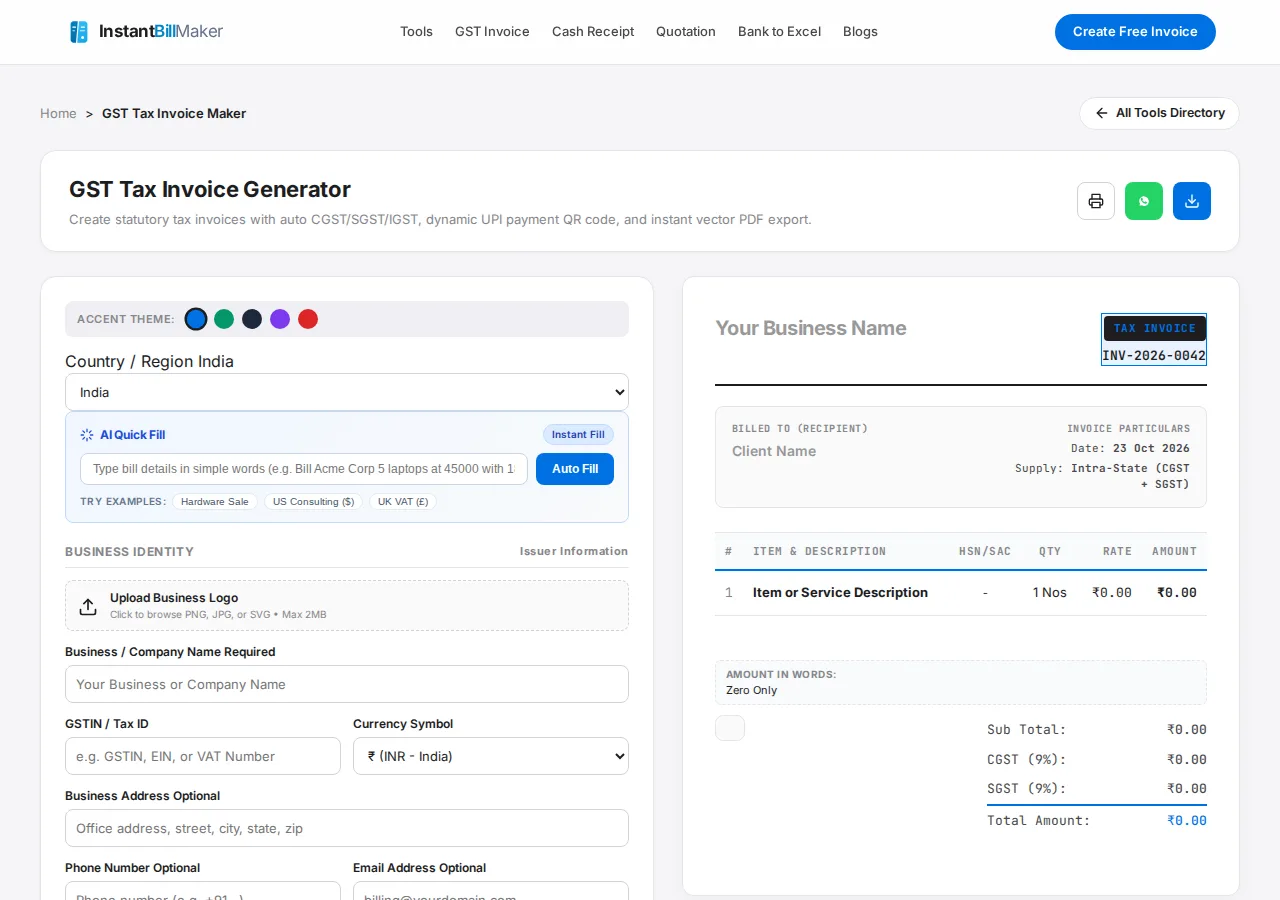
This guide explains invoice billing in plain language: what each document does, how billing and invoicing fit together day to day, and how to create a compliant bill in the browser without signing up. If you only need a ready file, jump to the free GST invoice maker.
Invoice billing meaning in everyday business
When a shop, contractor, or freelancer says they “do invoice billing,” they mean the full loop: list the work, calculate tax, send the document, track who has paid, and keep a copy for the books. The invoice is the request. The bill is what the buyer owes.
In casual speech people swap the words; in accounting software and GST filings the distinction still matters.
A billing invoice for a registered seller usually carries the particulars the Central GST Rules expect on a tax invoice.
It needs your legal name and address, your GSTIN if you have one, the customer’s details, a consecutive serial number for the financial year, the date, HSN or SAC codes for each line, place of supply, taxable value, and the tax split.
Miss those fields and input tax credit can stall even when the work itself was delivered.
Invoice vs billing: what changes on the document
An invoice is created by the party who is owed money. A bill is often the copy the buyer uses to authorise payment. Retail till slips, restaurant bills, and utility invoices all sit under the same umbrella: they prove what was bought, for how much, and whether tax was charged.
In India there is a second layer. A tax invoice and a bill of supply are separate instruments under the CGST Rules. You issue a tax invoice for taxable supplies. You issue a bill of supply when you are exempt or when composition-scheme rules apply and you are not charging tax.
Choosing the wrong document is a compliance problem, not a wording preference.
For a longer walkthrough of that split, read Invoice vs Bill: Is an Invoice the Same as a Bill?
How billing and invoicing work step by step
- Capture the deal. Who is buying, what was supplied, agreed rate, and whether tax applies.
- Build the document. Line items with quantity, unit, rate, HSN or SAC, discount, and tax mode (intra-state CGST+SGST or inter-state IGST).
- Number it correctly. Rule 46 asks for a consecutive serial number for the financial year. Start at 001 if you have not issued one yet; do not reuse numbers after a credit note mess.
- Send and collect. Email or share the PDF. Add a UPI ID if you want a scannable payment QR on the sheet.
- Record it. Mark the invoice paid, keep the file for the statutory period, and reconcile against your bank or UPI ledger.
Steps 2 and 3 are where most small businesses lose time. Spreadsheets break when tax mode changes mid-month. Word templates hide formulas. A browser tool that recalculates totals as you type removes that friction.
What a compliant Indian billing invoice must show
- Supplier name, address, and GSTIN (or a clear note if unregistered)
- Invoice number and date within the financial year
- Recipient name, address, and GSTIN when they are registered
- Description, HSN or SAC, quantity, unit, unit price, and taxable value
- Place of supply and whether the supply is intra-state or inter-state
- Tax rate and amount (CGST/SGST split or IGST)
- Signature or digital authentication as required for your registration
Section 31 of the CGST Act governs when a tax invoice must be issued for goods versus services. Rule 46 lists the particulars. This site’s tools follow that field list so you do not have to memorise the rule text every time you bill a client.
Hourly billing vs fixed-amount billing
Consultants and freelancers often prefer hourly billing: one line for hours worked at an agreed rate, sometimes a second line for reimbursable costs.
Contractors on site more often bill in stages, material, labour, and a progress percentage on the contract value. Both styles still produce a tax invoice if you are registered.
The only difference is how the line items are written.
If you bill by the hour, keep a short note in the description (week, project code, or milestone). Clients pay faster when the narrative matches their own timesheet.
Free bill generator vs Excel template vs paid software
| Approach | Good for | Watch-outs |
|---|---|---|
| Free online bill generator (this site) | Fast PDF, UPI QR, no signup | Need browser; store your own copies |
| Excel or Word template free download | Offline edits, custom columns | Broken formulas, wrong tax mode, weak serial control |
| Paid billing software | Many users, inventory, e-invoicing portals | Monthly cost, lock-in, training |
Most small Indian businesses only need a clean A4 PDF, a valid serial number, and a tax split that matches the place of supply.
That is the product surface InstantBillMaker ships: GST invoices, cash receipts, quotations, delivery challans, purchase orders, proforma invoices, HRA rent receipts, and bank-statement conversion, all in the browser.
Billing invoice meaning for GST returns
Your GSTR-1 table pulls invoice-level data: recipient GSTIN, invoice value, taxable value, rate, and place of supply. If the paper document disagrees with what you upload, the mismatch shows up as notices or blocked credit on the buyer’s side.
Clean invoice billing is therefore not aesthetics, it is the source of truth for the return.
Keep these habits:
- One serial series per financial year; never restart mid-year without a note.
- Inter-state only when place of supply crosses state lines, or when IGST appears on the document.
- Credit notes share the same discipline as invoices: reason, reference number, and tax reverse entry.
Make an invoice free (no signup)
You do not need an account to create a bill here. Open the GST Tax Invoice Maker, enter firm details and line items, check the live A4 preview, then download the PDF or print it. Cash receipts, quotations, and challans use the same flow on their own tool pages.
If you only needed the definition: an invoice billing document requests payment and carries the tax particulars; a bill is the buyer’s side of the same transaction. Build it once, number it correctly, and the rest of the compliance chain becomes boring, which is exactly what you want.
FAQ
Is invoice billing the same as a bill?
In conversation, yes. In GST law, a tax invoice and a bill of supply are different documents. The seller issues the invoice; the buyer records it as a bill to pay.
What is the minimum a billing invoice must include in India?
Name and address of supplier and recipient, GSTIN where applicable, consecutive invoice number and date, description with HSN or SAC, taxable value, tax rate and amount, and place of supply. Rule 46 of the CGST Rules lists these particulars.
Can I bill hourly and still stay GST compliant?
Yes. Describe the service, hours, and rate as line items. Tax mode still follows place of supply, not whether you charge by the hour or a fixed fee.
Do I need paid software for invoice billing?
Not for a small catalogue. A free browser generator that outputs a clean A4 PDF covers most shop, freelance, and contractor work. Move to paid software when you need multi-user access, inventory, or portal automation.
Where can I create a free bill online?
Use the free bill generator on InstantBillMaker: no card, no trial, no watermark. Start with the GST invoice tool or the cash receipt tool depending on the document you need.
Related guides
For how payment terms work on an invoice, read Invoice Payment Terms Explained. For the document chain before invoicing, see The 7 Steps of the Purchase Order Process. For tax compliance across countries, see VAT vs GST vs Sales Tax. For collecting money on overdue invoices, see How to Follow Up on an Unpaid Invoice. For Indian cash receipt limits, see Cash Payment Receipt Rules in India. For the IRN and QR code rules behind B2B invoices, see E-invoice in India. For charging interest after a due date passes, read Interest on Late Payment of Invoice in India.